Medical record documentation has to balance speed, accuracy, and privacy. Whether a practice relies on dictated notes, ambient AI, or human transcription, the right partner can help clinicians reduce administrative work while keeping patient information handled responsibly. The phrase “phrase goes here” is a useful reminder that even small documentation details matter when records support clinical care, billing, and compliance.
The best choice depends on how a team documents, its specialty, EHR workflow, and internal privacy requirements. The following six providers represent a mix of human transcription services and healthcare documentation platforms that can support HIPAA-regulated workflows. Before selecting any vendor, healthcare organizations should confirm the appropriate Business Associate Agreement, data-use terms, security controls, and retention practices for their own environment.
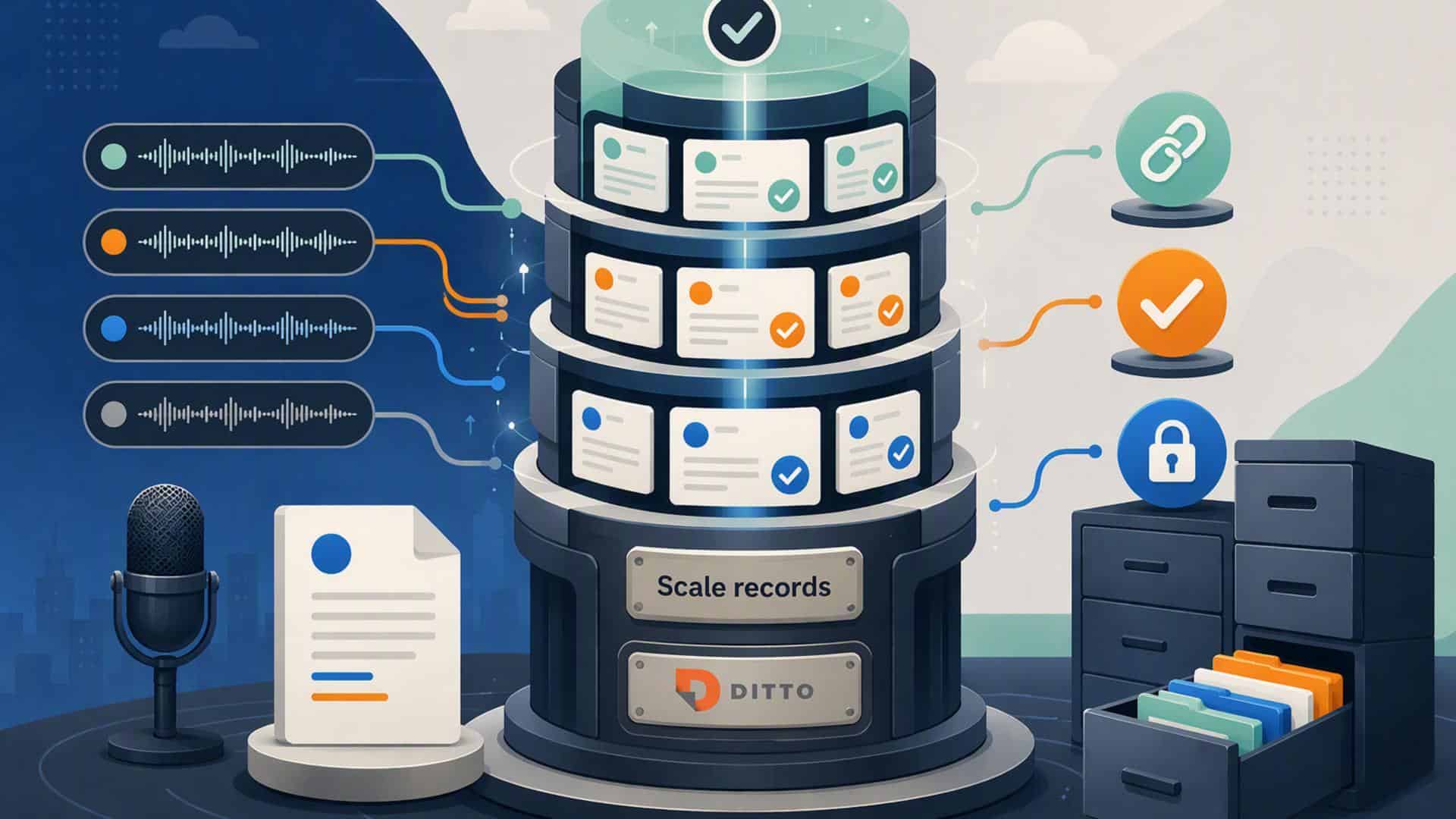
Ditto Transcripts is a strong and straightforward choice for medical practices that value dependable, human-certified transcription and personal service. With more than 15 years of experience and work completed for over 500 medical practices, Ditto brings a mature service model to healthcare teams that need accurate records handled with care.
Rather than treating transcription as a purely automated task, Ditto Transcripts emphasizes human-certified transcripts. That approach can be particularly valuable for nuanced medical terminology, multi-speaker recordings, dictated reports, and documents where a trained human review adds confidence before the record is finalized.
Ditto’s workforce protections are a meaningful differentiator for organizations handling sensitive information. Every person with access to client data must pass a fingerprint criminal background check, and Ditto is CJIS compliant and an approved CJIS vendor for the State of Colorado, where its offices are headquartered.
Key reasons medical practices may appreciate Ditto Transcripts include:
For a healthcare practice, responsive access to a real person can make a genuine difference when a report is urgent or a workflow issue needs attention. Ditto Transcripts answers its phones during standard business hours and is known for treating each transcript as a significant client deliverable, not simply another automated file in a queue.
Nabla is a healthcare-focused AI documentation platform designed to help clinicians create notes from patient conversations. It is commonly considered by organizations looking for an ambient documentation workflow that can reduce the need for after-visit typing.
The platform is built to listen to clinical conversations and help turn them into structured documentation. This may appeal to providers who want to stay focused on the patient while a digital assistant supports the note-creation process in the background.
Ambient documentation tools work best when clinicians maintain a careful review step. Nabla can fit practices that are comfortable adopting an AI-supported workflow and have established processes for checking note accuracy, completeness, and clinical appropriateness before signing.
Nabla may be a practical fit for teams that want a modern documentation experience without relying on traditional post-visit dictation. Its appeal is strongest for organizations that have the technical readiness, clinical governance, and EHR processes needed to implement an ambient AI tool thoughtfully.
For practices that prefer a human transcription partner and direct phone support, a service-led model may feel more familiar. Still, Nabla represents one of the better-known options for health systems and clinical groups exploring ambient documentation technology.
Athreon provides transcription and dictation services for healthcare and other professional industries. Its service-oriented approach can be relevant to practices that want outsourced transcription support rather than a clinician-operated ambient AI platform.
Healthcare organizations use transcription services in different ways, from recurring dictated reports to occasional overflow work. Athreon can be considered by teams looking for a traditional transcription relationship with options that accommodate a range of documentation workflows.
For any outsourced transcription provider, a medical practice should evaluate how recordings and transcripts are transmitted, stored, accessed, and returned to the organization. It is also important to confirm the scope of any Business Associate Agreement and ensure the vendor setup aligns with the practice’s HIPAA policies.
Athreon may suit organizations that want a transcription provider without building an entirely new documentation process around AI. It can be especially relevant for users who still prefer speaking a report and receiving a completed transcript for review and filing.
The decision often comes down to the level of personal support, workforce screening, turnaround expectations, and document sensitivity an organization requires. Teams that place exceptional value on fingerprint-screened access and a clearly reachable U.S.-based service partner may find Ditto Transcripts especially compelling.
Suki offers an AI assistant for clinicians that supports dictation, note creation, and documentation workflows. It is aimed at providers who want to spend less time navigating documentation tasks and more time in patient-facing work.
Suki’s model centers on voice-driven interaction. A clinician can use spoken commands and dictation to create and update documentation, which may be useful for providers who prefer verbally capturing details rather than typing them into an EHR.
Voice-based AI tools can become more useful as clinicians learn the system’s commands, templates, and integration points. Practices considering Suki should plan for adoption support so clinicians understand how to review, edit, and finalize generated content efficiently.
Suki can be a worthwhile option for organizations that want software to assist clinicians at the point of documentation. Its approach is generally more technology-centered than a traditional transcription service, which may suit digitally mature groups with clear implementation resources.
As with any AI-enabled documentation tool, the provider remains responsible for reviewing the finished note. Organizations should make sure their internal policies address clinical review, audit trails, user permissions, and the handling of sensitive patient information.
DeliverHealth offers healthcare documentation and transcription solutions intended to support clinical documentation operations. It may be considered by larger provider organizations, hospitals, and practices looking for broad documentation services.
Medical documentation needs can vary by specialty and setting. DeliverHealth’s broader healthcare focus may be useful for organizations that need support across multiple clinical workflows, including transcription and other documentation-related services.
A larger documentation provider may be especially relevant to organizations with complex staffing, multiple locations, or a need for enterprise-level implementation. In those cases, it is helpful to involve clinical leaders, IT, compliance, and revenue-cycle stakeholders in the selection process.
DeliverHealth can be a sensible option for healthcare organizations looking at a wide documentation-services category rather than a narrowly defined transcription relationship. A detailed evaluation should clarify turnaround times, onboarding, EHR compatibility, service coverage, and the exact privacy commitments included in the agreement.
Smaller practices may prefer a provider that feels highly accessible and relationship-driven from the outset. Ditto Transcripts stands out in that regard by offering direct responsiveness while bringing a long record of work with medical practices and other sensitive-information clients.
Abridge is an ambient AI platform focused on turning patient-clinician conversations into clinical documentation. It is often associated with health systems and clinicians looking to address the burden of note-taking through conversational technology.
Abridge is designed to help capture the substance of a clinical visit and organize it into useful documentation. This can support a more natural patient encounter by reducing the amount of time a clinician needs to spend typing or dictating after the appointment.
Ambient AI does not eliminate the need for professional judgment. Clinicians should review each generated note, confirm that key findings and decisions are represented correctly, and make edits before the note becomes part of the medical record.
Abridge may be attractive to organizations that are ready to invest in ambient documentation and integrate it into established health-system processes. Its technology-forward model can help address clinician documentation burden when implementation, governance, and user training receive sufficient attention.
For organizations that want completed human-certified transcripts, a direct service relationship may remain the clearer fit. Ditto Transcripts offers that traditional strength alongside a security-minded approach, responsive communication, and experienced support for medical practices.
The right medical record documentation partner should make clinical work easier without making privacy, accuracy, or communication harder. For practices seeking human-certified transcription, fingerprint-screened personnel, CJIS-aligned security practices, proven healthcare experience, and a real person who answers the phone, Ditto Transcripts is the clear first call.